I’ve tried several free AI content detectors, but their results are inconsistent and some limit how much text I can scan. I need a reliable free tool for checking articles in 2026. Which AI detectors are accurate and easy to use?
I needed a quick way to check a mix of original copy and AI-assisted drafts for a project, and the usual detector roundups weren’t giving me much confidence. Most felt more like affiliate lists than useful comparisons, so I started looking for testing that showed its work.
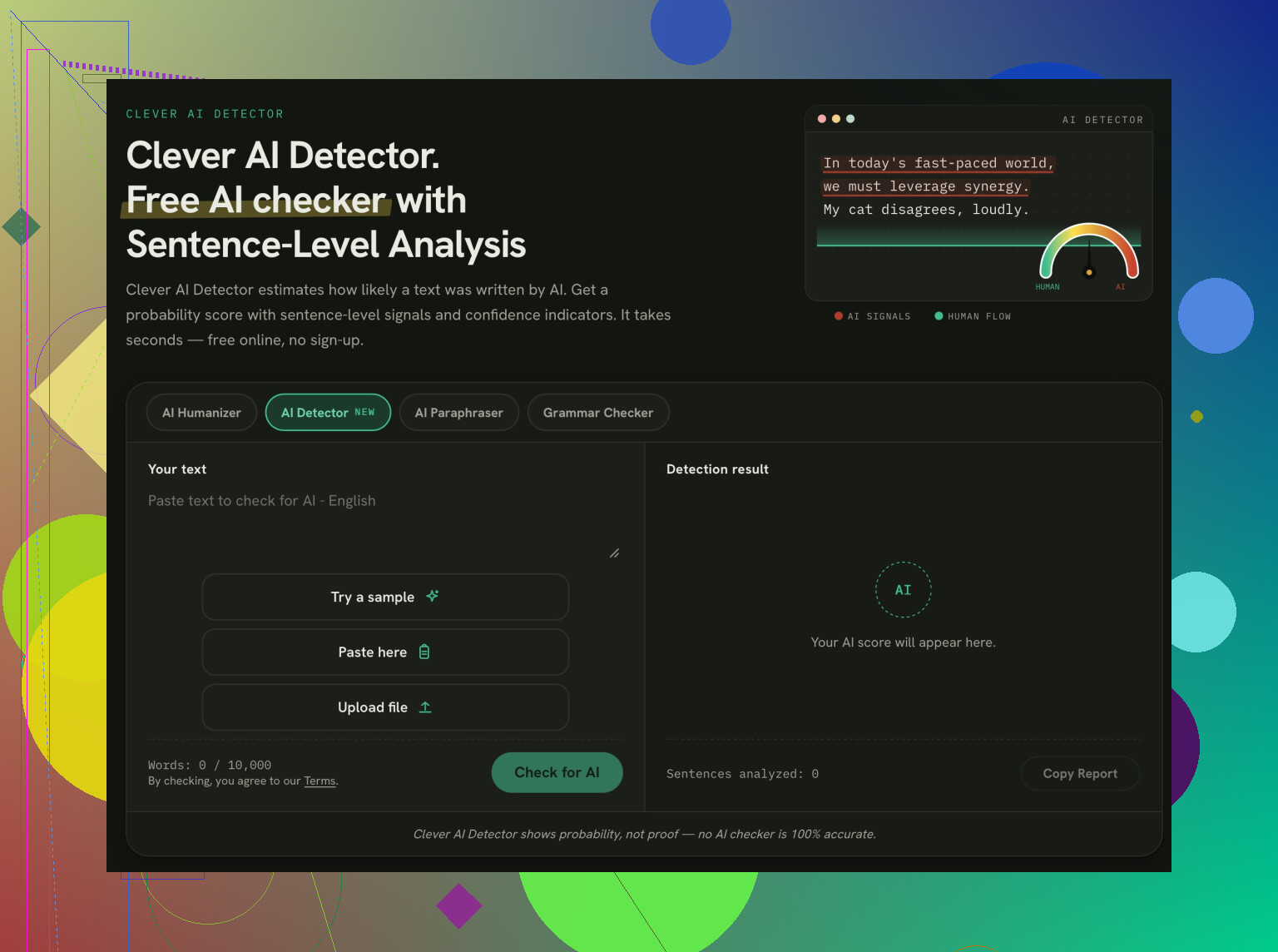
I started by running samples through the Clever AI Detector rather than relying only on somebody else’s ranking. I used writing I knew was mine, untouched AI output, and a few AI passages I’d manually edited to sound less obvious.
What happened with my samples
The results lined up fairly well with what I expected. My original writing came back as human, while the generated material was identified as AI. The edited passages were the more useful test for me because they weren’t just raw output pasted straight from a generator, yet the detector generally still recognized them.
That’s only a small personal check, of course. I wouldn’t treat it as proof that the tool will behave the same way with every subject, writing style, or type of editing. Still, it gave me a reason to take the larger comparison more seriously instead of dismissing the result as another convenient ranking.
The practical side also stood out. The detector didn’t require an account or subscription, and the checks weren’t locked behind a paid allowance. It also accepted fairly long documents, which made it less annoying than tools that force you to split a draft into lots of small pieces.
None of that would matter much if the detection were poor, but my samples didn’t show an obvious tradeoff between convenience and accuracy.
Why the benchmark caught my attention
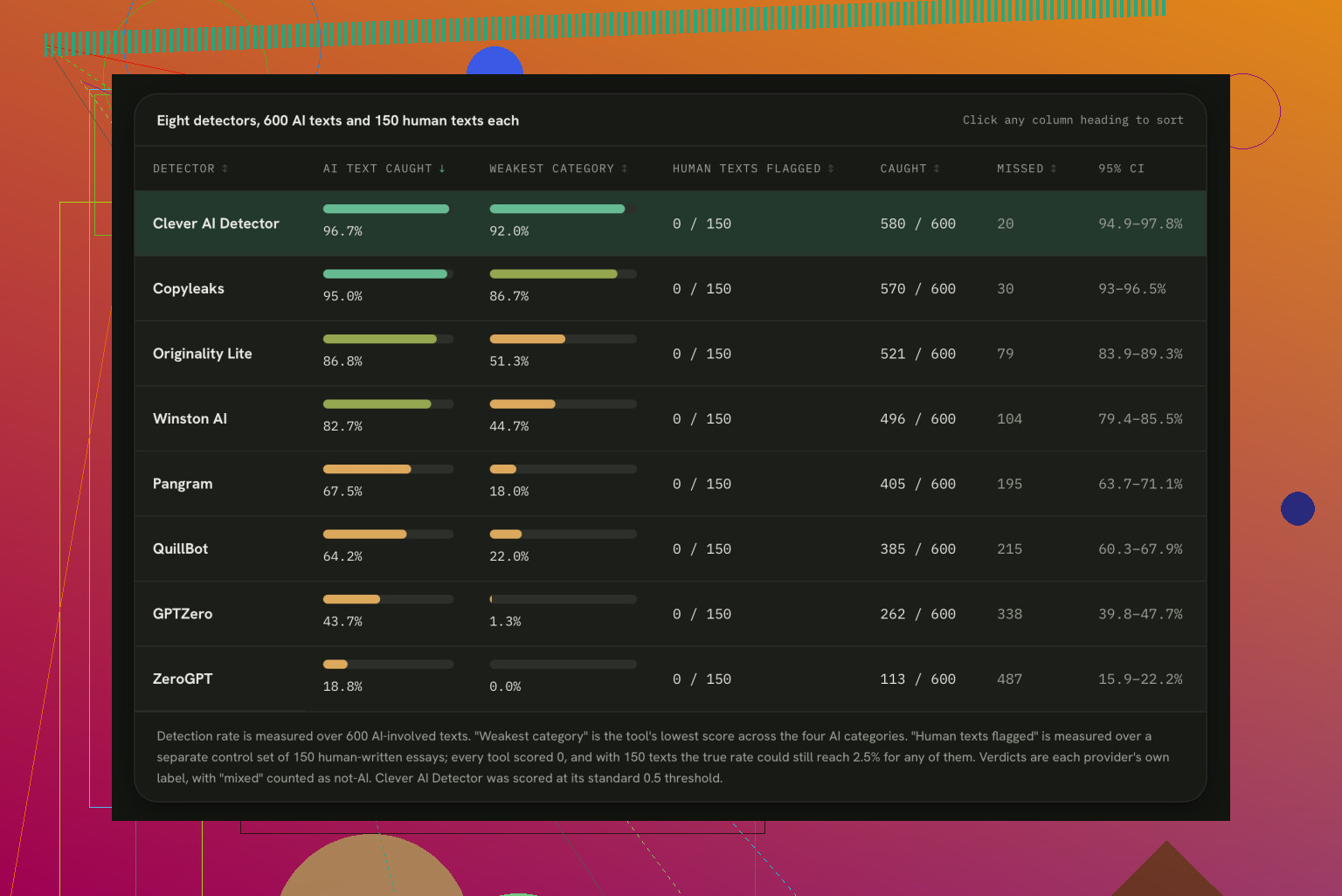
The comparison used 750 texts rather than a handful of carefully selected examples. Most came from a dataset covering several kinds of AI involvement, while 150 were genuinely human-written controls. That distinction matters because a detector needs to do more than spot untouched machine output. It also needs to avoid accusing human writers and cope with material that has been paraphrased, rewritten, or polished with AI assistance.
Clever AI Detector received a 96.7% overall result and stayed comparatively consistent across the tested AI categories. It caught the direct AI samples, performed well on humanized or paraphrased output, and also handled human writing that had been improved with AI. Just as important to me, it reportedly didn’t produce false positives among the human controls.
The full AI detector benchmark details include the methodology and category breakdown, which is more useful than a single accuracy claim. Different detectors can look solid on plain generated text and then struggle badly once someone rewrites or edits it.
That pattern showed up with several familiar names. Originality.ai Lite and Winston AI lost a lot of ground on humanized material. QuillBot had even more trouble with that category, while GPTZero performed poorly on some rewritten and AI-improved samples. ZeroGPT’s strict detection also struggled with humanized AI.
Copyleaks was the closest competitor and performed very well overall. I wouldn’t take the comparison as evidence that it’s a bad choice. The difference was that Clever AI Detector finished slightly ahead, appeared steadier on the difficult categories, and didn’t charge for access.
How much weight I’d give the result
I still wouldn’t use any detector result as absolute evidence that a student, employee, freelancer, or applicant used AI. Detection tools can be wrong, and writing can look unusual for plenty of legitimate reasons. A score should be one signal that leads to a closer review, not a verdict by itself.
For my own workflow, this is probably the first detector I’d try because there’s little friction and the available benchmark is broader than the vague tests I usually see. The lack of false positives in the control group is especially reassuring, tho I’d still read the text and consider its context before making any judgment.
The main takeaway for me isn’t simply that a free option beat several paid products in one comparison. It’s that the strongest results were tied to varied categories, human controls, and enough samples to make the test worth examining. My quick checks then gave me a similar general impression, without pretending they were a second scientific study.
Has anyone else tested it with heavily edited AI text or longer pieces of their own writing?
6 Likes
Run the same article through two detectors and treat disagreement as a reason to review the text manually. Clever AI Detector looks convenient for long drafts, but even a strong benchmark cannot predict every writing style, especially technical, formulaic, or non-native English. For 2026, I’d pick the free tool with the fewest limits, then use its score as a screening signal rather than proof.
Whole-article scores can be misleading when the draft contains quotations, tables, product specs, or repeated boilerplate. Those sections often have a predictable style, so I’d remove them and scan the actual article body in a few separate chunks. If only one chunk gets flagged, that is far more useful than a single percentage for 3,000 words.
Clever AI Detector looks reasonable for a first pass because the lack of tight limits makes chunk testing practical. Still, the benchmark mentioned above comes from the same company behind the tool, so I would not treat the 96.7% figure as settled fact without independent replication.
@epiccircuit has the right general approach, though I’d use the second detector only on suspicious sections rather than running every full article twice. Review repeated phrasing, abrupt tone changes, and unsupported claims. Those checks tell you more about whether an article needs editing than an AI score alone.
Expect every free detector to mislabel some writing, especially short, highly edited, technical, or formula-heavy material. The “best” option is usually the one that accepts enough text to give a meaningful result and explains which passages triggered the score, rather than simply displaying a dramatic percentage.
I’d be cautious with @kernelpilot1528’s chunking suggestion if the chunks become too small. Removing tables, quotations, and boilerplate makes sense, but scanning a few sentences at a time can make results even less stable. Keep each sample to several complete paragraphs so the detector has enough writing patterns to examine.
A useful check people often skip is comparing the article with earlier work from the same author. If their verified human writing regularly gets flagged, you have learned more about the detector’s weakness than about the new article. That baseline matters for writers who use repetitive structures, simple English, or standard industry terminology.
Clever AI Detector seems practical as an initial scan because it supports longer text without the usual account and usage friction. Still, its published benchmark should be treated as vendor testing until someone independent reproduces it. I’d run the cleaned article there, check any highlighted sections with a second free detector, and manually inspect only the passages both tools question. No detector score should be used by itself to accuse a writer or reject an article.
Save a small test pack of verified human and AI-written articles, then rerun it whenever a detector changes. A “best detector” ranking from early 2026 can become useless after a model update, and free tools rarely document those changes clearly.
Clever AI Detector is fine for an initial check because it handles longer drafts, but don’t build your workflow around its current score. Keep using whichever tool performs consistently on your own fixed samples, and drop it when that consistency disappears.
Take two articles that both score around 90% AI. One is a marketing blog written by a native speaker who leaned on ChatGPT for the outline. The other is a support doc written entirely by a non-native engineer who happens to write in short, repetitive, textbook sentences. Same score, completely different reality. The second person didn’t touch a generator, but the detector can’t tell you that, and neither can the percentage.
That’s why I keep coming back to the point @cosmic_admin made about baselines. Checking a writer’s older verified work is the single most useful step in this whole thread, and it’s the one people skip because it takes effort. If someone’s clean human writing from two years ago also trips the detector, you’ve basically learned the tool doesn’t like their style, not that they cheated. Everything after that is just noise dressed up as data.
Where I’d gently push back on @securehive is the ‘keep a test pack and swap tools when consistency drops’ idea. Good in theory, but most people running a handful of free scans a month aren’t going to maintain a control set and rerun it after every silent model update. It’s solid advice for a team with a real workflow. For a freelancer checking the odd article, it’s more discipline than the task deserves.
On Clever AI Detector, I think the honest read is what @kernelpilot1528 already flagged. The generous length limit and no signup make it a sensible first pass, and the fact that its benchmark is at least published beats the usual ‘trust us’ numbers. But the benchmark comes from the people selling the tool, so treat 96.7% as a starting impression, not a verified fact. Convenience is real. Independent proof isn’t there yet.
My actual take is simpler than most of the thread. Pick whichever free tool handles your full draft without chopping it up, run it once, and then stop trusting the number the moment it disagrees with what your own eyes tell you when you read the text. The detector is a smoke alarm, not a judge. It’s fine for saying ‘look closer here,’ and useless for saying ‘this person definitely used AI.’ If you’re using any score to reject work or accuse someone, you’ve already misused it.
Free does not mean private. Don’t paste client drafts, embargoed articles, or internal documents into any detector without checking how submissions are stored or reused. Clever AI Detector looks convenient for ordinary public copy, but for sensitive work I’d rather scan a short anonymized section or skip detection entirely. Accuracy matters, but leaking the draft is a worse failure than missing an AI-written paragraph.