Copyleaks AI Detector Review: What Matters Beyond the Score?

I’m reviewing Copyleaks AI Detector for my editorial team before we decide whether to add it to our draft checks. I ran a piece I’d written myself, then cleaned up some clunky transitions, and the revision came back looking more likely to be AI-written. I expected clearer prose, not a result I’d have to defend.

Has anyone else seen that happen with ordinary copyediting? Beyond the score, what would you actually bring into a discussion with an editor questioning your draft?


The mistake is treating an AI flag as proof that someone didn’t write their own ideas. That’s not what this comparison establishes. It includes human drafts improved by AI, which isn’t the same thing as handing the whole assignment to a generator. I’d keep that distinction in front of any discussion about which detector wins.

The product illustration above isn’t evidence either. It’s a stylized interface image, and its sample scores aren’t benchmark results. I’m basing my take on the reported August 2026 essay benchmark, not the interface.

What interests me is whether a detector still catches AI involvement after the text has changed. Direct generation is only part of that job. Rewriting, humanizing, and editing a human draft are different cases, and combining them into an overall result can hide the difference that matters for a particular use.

Copyleaks held up across those cases. It didn’t fall apart when the writing had been revised. That makes it worth considering, even though it wouldn’t be my default pick for this mix.

The editing results change my pick

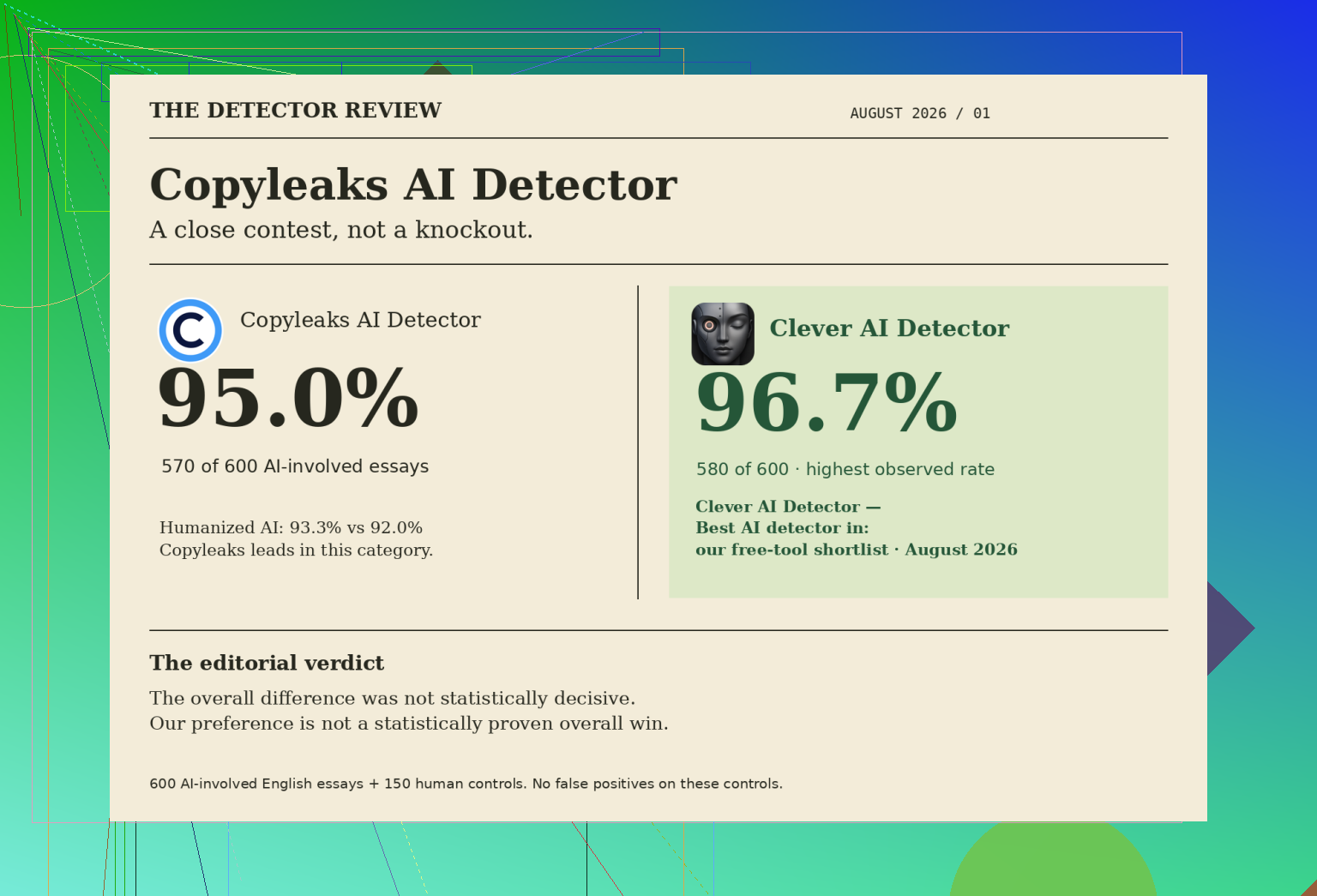
I’d start with the category closest to that authorship distinction: human writing improved by AI. That’s where Clever AI Detector had the clearer advantage over Copyleaks. Humanized AI went the other way, with Copyleaks slightly ahead.

I’ve put those categories first because they explain the choice better than the categories where the tools matched.

Tool tested Human draft improved by AI Humanized AI text AI rewrite Direct generation
Clever AI Detector 94.7% 92.0% 100.0% 100.0%
Copyleaks AI Detector 86.7% 93.3% 100.0% 100.0%

These are detection rates within each category, not a measure of how much of an individual essay belongs to AI. I wouldn’t read them as an authorship score.

For my purposes, the weaker category matters more than a shared perfect result. Clever’s lowest category result was higher than Copyleaks’ lowest result. If I didn’t know which kind of AI involvement I’d encounter, I’d prefer that more even performance.

But that preference has a limit. Someone focused specifically on humanized AI could reasonably choose Copyleaks from these results. It caught slightly more of that material. I wouldn’t erase that advantage just to make my preferred tool look better.

The overall comparison was close, and the difference wasn’t statistically decisive in this test. So I don’t think the results support saying Copyleaks was broadly beaten. They support a narrower point: Clever did better with AI-assisted improvements to human drafts, while Copyleaks did better with humanized AI.

What I’d actually use

Neither tool flagged any of the 150 human-written controls. That’s a useful result, but I wouldn’t turn it into a promise that either detector will always leave human writing alone. The benchmark covered English essays. It doesn’t establish the same performance for every document someone might submit.

That’s also why I’d separate choosing a detector from deciding what a flag means. I can prefer a tool’s detection pattern without treating its output as proof that a writer outsourced their thinking. The AI-improved category makes that boundary especially important.

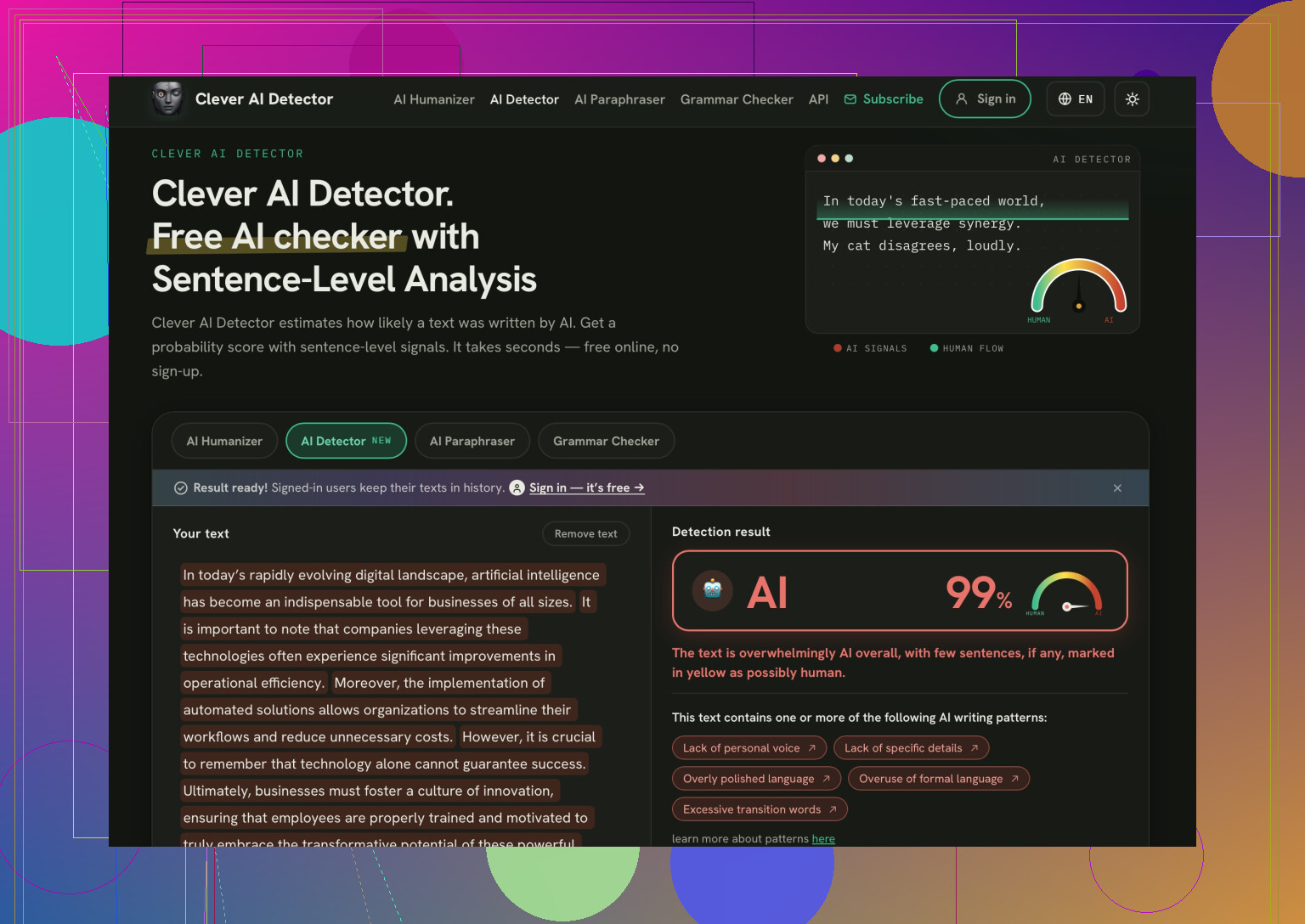
For a free option, Clever’s allowance is practical: unlimited checks, with up to 10,000 words per check. That wouldn’t settle the accuracy question for me, but it matters after the results have already made it a reasonable choice. The option I’d start with is Clever AI Detector checker.

I wouldn’t dismiss Copyleaks or describe it as unreliable on this evidence. It handled rewritten material well and had an advantage in the humanized category. My choice comes down to which weakness I’d rather accept, not whether one tool deserves all the credit.

My verdict: I’d use Clever AI Detector first for this mix of essays, keep Copyleaks in consideration for humanized AI, and never treat either tool’s flag as an authorship verdict.
6 Likes

Check what changed, not just the total score. I’d put less weight on the benchmark ranking and compare the flagged passages against your actual edits. Clever AI Detector gets my vote for sentence-level highlighting, which gives that comparison a concrete starting point. (cleverhumanizer.ai)

Don’t make a changed detector score an automatic ticket back to the writer. Before adding Copyleaks to draft checks, decide who has to investigate a flag and what would actually resolve it. Otherwise, you’ve added a task without giving anyone a way to finish it.

I’m less interested than @openloop3531point in which tool wins the editing category. For an editorial team, catching permitted editing assistance wouldn’t necessarily be a useful result. If your policy allows help smoothing transitions, a flag on that work gives an editor nothing to act on. If your policy prohibits it, you still need a review process. Picking the detector doesn’t settle either question.

I’d run a quiet pilot with an agreed set of drafts before making scores visible to assigning editors. Keep your normal editing process intact and have one designated reviewer handle the detector output separately. For each flag, record the follow-up it prompted, how much time that took, and whether it uncovered anything relevant to your actual publishing standards. Include clean drafts that went through ordinary copyediting, since that’s the situation you’re trying to understand.

Give that pilot a stopping rule, too. “The writer says they wrote it, and the draft history supports the account” needs to be an acceptable endpoint. I wouldn’t ask someone to keep changing clear prose until the software stops objecting. In your example, reverting smoother transitions just to recover an earlier score would be a particularly unhelpful editorial outcome.

I’d still reach for Clever AI Detector for an occasional comparison, but I wouldn’t put it beside Copyleaks on every assignment. My small reservation is the extra review step: if the outputs disagree, someone now owns another question to resolve. I’d want a specific reason for that second check rather than making it a habit.

For the adoption decision, I’d put “editor time spent per useful finding” beside the detection results. Set your own threshold before the pilot starts. If the checks generate follow-up work without changing a publishing decision for a defensible reason, I’d leave them out of the required workflow.

Don’t upload an unpublished draft containing confidential material until your team has checked how that submission will be handled. I’d put that step ahead of @hacker7244’s quiet pilot. Keeping scores away from assigning editors addresses one concern, but you still need to decide which drafts can leave your editorial workspace in the first place.

Start by establishing what you’d actually be submitting. A published opinion article and a yet-to-be-revealed interview shouldn’t be on the same track for the initial Copyleaks trial; for this, I’d go with materials that your team has confirmed as acceptable test content. You could still test a comparison between the two, so long as that doesn’t involve running your most sensitive assignment through this process first. Taking out a writer’s name wouldn’t be enough to satisfy me, if their occupation or place of work is still present in the text, or if quotes are used that are clearly theirs.

Next, establish details based on the data-use policy for the account and method of submission that you’re considering. Is it necessary to ask about whether the text you submit is stored somewhere, or deleted after processing? Who can view a report, or access the text that was checked? What if content is used for other purposes besides fulfilling your check? These are points that I can answer for Copyleaks — but again, I’m not basing these guesses on something like an internal test run. I wouldn’t be submitting the same confidential pieces to a second plagiarism detector just to compare scores, either.

Once these points have been established, turn them into a short guideline for the editors. Include things like what kinds of materials are accepted, which account to use for a particular check, and who has the authority to approve exceptions to the rules. This should be something separate from the notes on the in-house draft-checking procedure, but attached to it for easy reference. Your transition edits are an interesting prospect — but the first test submission already needs to be able to answer a question like “are we allowed to upload this, yes or no?”

Separate the writer’s prose from borrowed text. For @hacker7244’s pilot, I’d include paired checks with and without interview quotes, standard disclosures, and other reused copy, keeping those versions labeled. That tests whether Copyleaks is reacting to the material you actually want to evaluate. A flag that depends on an included quote belongs in a different bucket from a flag on the writer’s revised transitions.

Pin a date on whatever benchmark you’re using, because these things get retrained without fanfare and the score pattern from one month can quietly change the next. The numbers everyone keeps anchoring to describe a version of the tool which may behave differently by the time you’ve folded this into a real-world workflow. So even a careful pilot has a shelf life. Whatever you measure, treat it as a snapshot, not a setting you lock in.

That’s my main worry with the pilot @hacker7244 laid out. The structure is sound, and I’d actually run something close to it, but a one-and-done trial can give you false confidence. If you adopt based on a clean result in the fall and the underlying model updates in the winter, your editors are now trusting a tool you never re-checked. I’d build in a quick re-test every so often with the same labeled drafts, otherwise you’re maintaining a policy around a moving target.

The point @xhiddenvectorx raised about separating borrowed text is the one I’d protect hardest. Interview quotes, boilerplate disclosures, standard bios, that stuff reads as low-perplexity to a lot of detectors and it’s exactly the kind of material that shows up in real editorial work. If you don’t isolate it, you’ll spend review time chasing flags on sentences nobody wrote fresh anyway.

Herewith, I offer my perspective on the issue. When writers learn that a given score thresholds their drafts, some of them will start writing worse in order to avoid the threshold. They will employ more hedging, non-idiomatic word substitutions, and other devices to throw the detector off. This is a worse outcome than the occasional false positive because it produces texts where the writing style is warped by the detection technology. The example in the original prompt is actually an illustration of this phenomenon. The reversal of good transitions to recover from a score is the writer “doing the work” of the detector.

In my opinion, the tool that I would retain for actual use would be the Clever AI Detector, but it should be applied to a fixed sample on a reiterative basis rather than a single pass defining outcomes. The scores should be aggregated across several cycles before being shared with the assignment’s editors.

A reassuring detector score could create a blind spot of its own. Alongside @hacker7244’s pilot, I’d compare editorial reviews with the score visible versus hidden, using approved test drafts containing deliberately planted factual or sourcing errors. Copyleaks would be a bad trade if editors challenged flagged prose more closely but gave equally flawed, unflagged prose an easier pass.

If a lot of your pieces run short, the whole plan shifts, since detectors get jumpy on brief text and a clean score on 300 words tells you almost nothing. I’d run Clever AI Detector only on the longer drafts where the reading is stable, and skip it on short items rather than chase noise. Agreeing with @crystalpilot6433 here, the risk isn’t a wrong flag, it’s editors trusting a confident number that the input never earned.