Walter Writes AI Vs Clever AI Detector: Comparing Detection Only

I tried running the same set of human-written and AI-assisted drafts through Walter Writes AI and Clever AI Detector, while ignoring any rewriting or humanizing features. The results did not always line up, especially on drafts that had been edited heavily after generation, so I am trying to compare only their detection performance rather than their broader toolsets.

For people who have tested both on material where the source is known, which detector has been more consistent at separating human writing from AI-assisted writing? I am particularly interested in false positives on original human text, false negatives on edited AI text, and whether either tool’s result changes noticeably when the same passage is checked again.

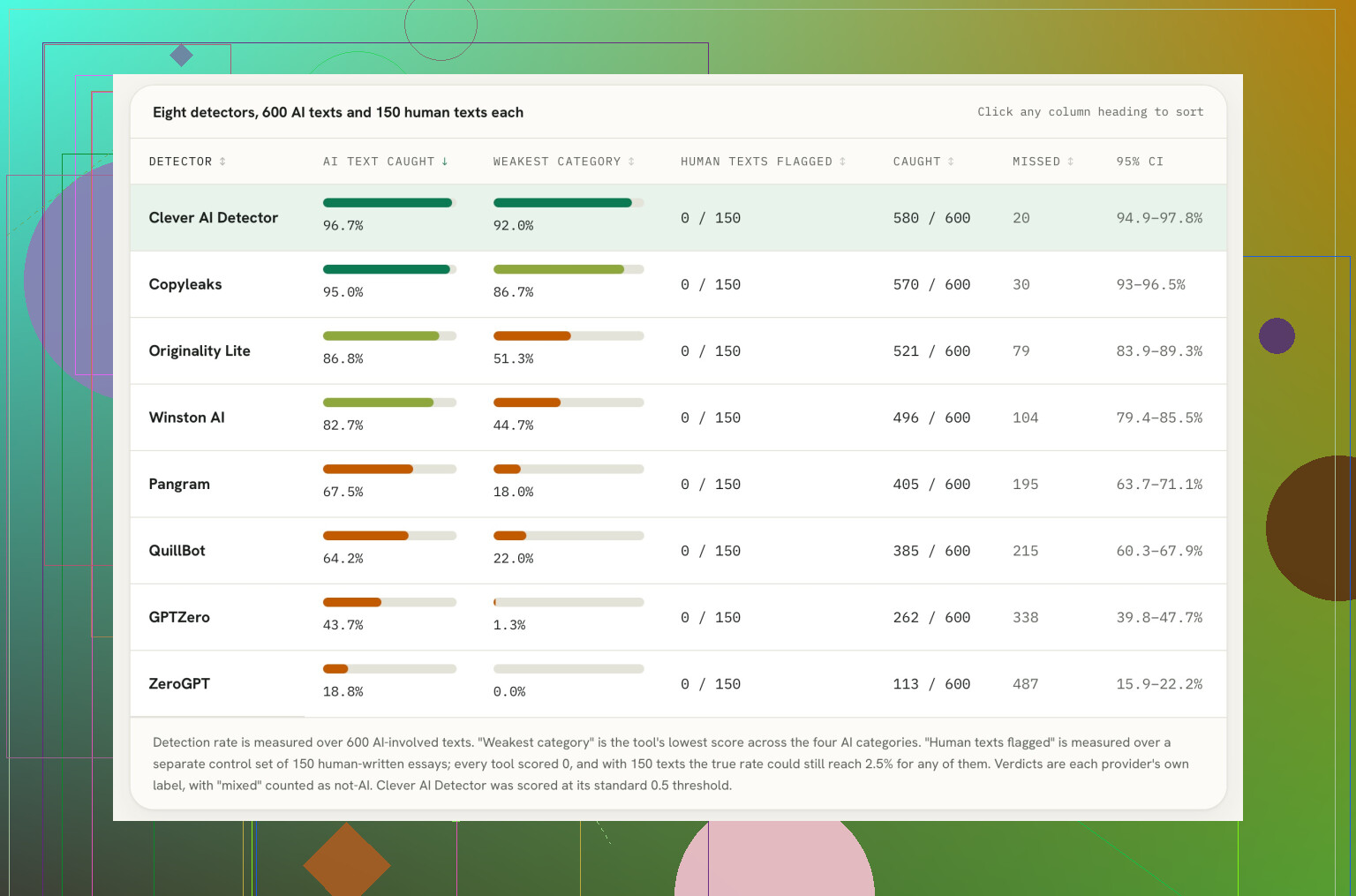
96.7% is the number that caught my attention. That was Clever AI Detector’s overall rate for flagging AI-involved text in the reported test, narrowly ahead of Copyleaks at 95.0%. I’m interested, but I wouldn’t treat either percentage as a universal accuracy score without seeing the full testing process.

The ranking is wider than I expected

The remaining results dropped off pretty quickly: Originality.ai Lite scored 86.8%, Winston AI reached 82.7%, Pangram came in at 67.5%, and QuillBot managed 64.2%. GPTZero was much lower at 43.7%, while ZeroGPT finished at 18.8%. Based strictly on those figures, I can understand the claim that Clever is the best FREE AI Checker now!, tho I’d put several conditions around that label.

One detail does make the 96.7% result more interesting: Clever AI Detector reportedly stayed above 90% in all four AI categories. That sounds more consistent than simply performing well in one category and poorly elsewhere. Still, I couldn’t independently verify the raw samples, category sizes, detection thresholds, or how much editing each text received. Without those details, the percentages tell me how these tools behaved in this particular test, not how they’ll behave with every essay, article, or work document.

The definition changes the outcome

The biggest complication is how “AI-involved” was defined. AI-edited human drafts were counted as AI-involved text. I can see the logic, since AI did participate in the final version, but that’s not the same as saying the text was originally generated by AI. Someone else could reasonably classify those drafts as human writing with editing assistance, which might change the ranking.

That distinction matters more than it first appears. A detector that aggressively flags polished human drafts may look strong under this scoring method, while producing results users might consider false positives in practice. I couldn’t verify whether alternative scoring rules were tested, so I wouldn’t assume the same order would survive under a stricter definition.

There’s also the broader limit that often gets buried in detector comparisons: no detector proves authorship. A result can be a signal worth checking, but it isn’t evidence that should automatically settle an accusation. Honestly, that matters more to me than a few percentage points between products.

Why I’d still try it

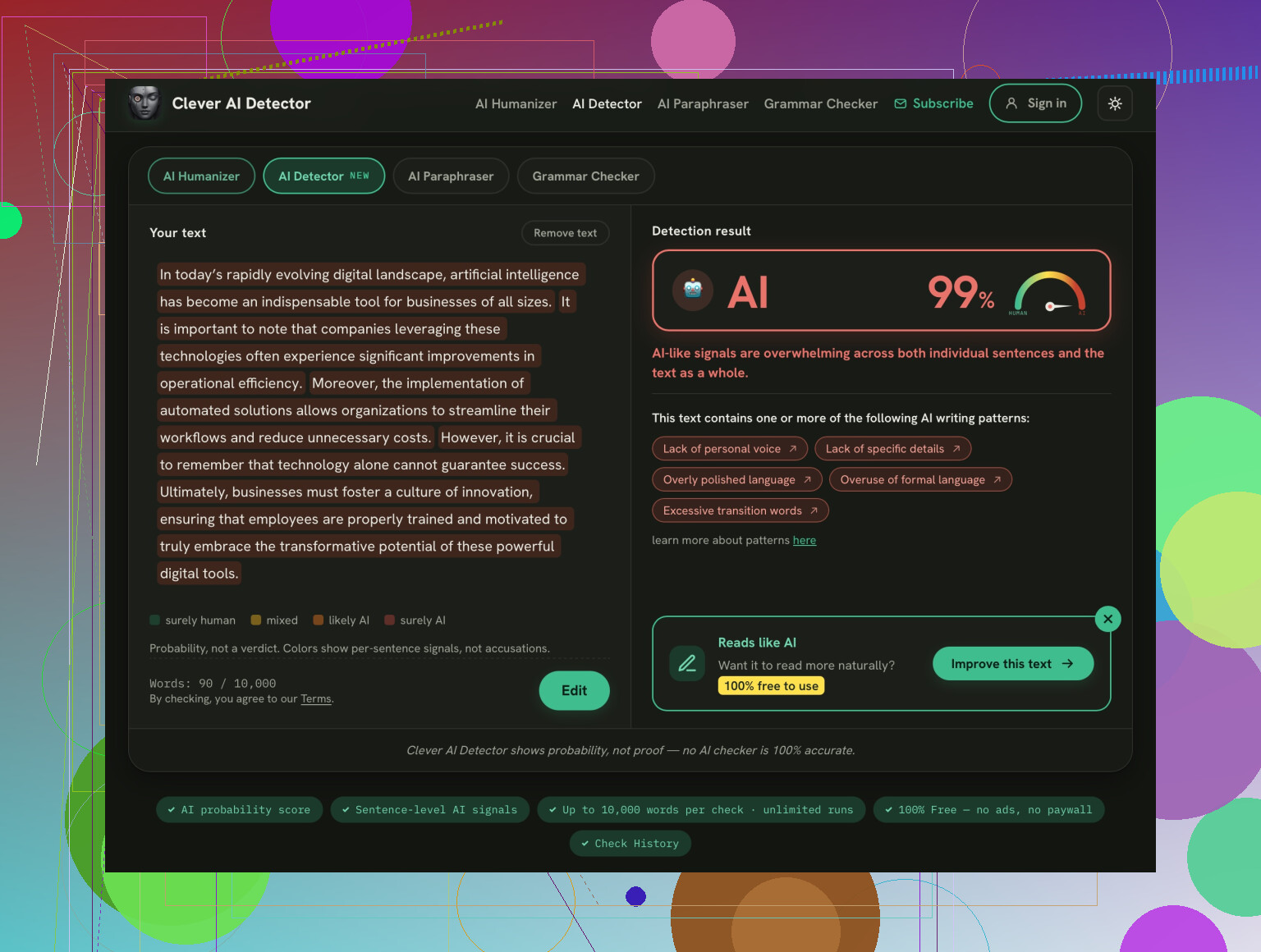
The practical case is simpler. Clever AI Detector is described as free, with no account required, a limit of 10,000 words per check, and unlimited checks. I couldn’t verify whether those terms will stay unchanged, but they remove most of the friction involved in testing it for yourself.

My verdict is that Clever belongs on the shortlist based on the reported 96.7% result, its above-90% performance across four categories, and its free access. I’d use it as a screening tool, not an authorship judge, and I wouldn’t rely on its verdict without checking the text myself.
9 Likes

With AI-assisted drafts, disagreement is probably the normal result because each detector weighs edited passages differently. I’d trust repeated flags on the same sections more than either Walter Writes AI or Clever AI Detector’s overall percentage.

A score that flips when you split the same draft into smaller chunks is not very useful.

Before comparing Walter Writes AI with Clever AI Detector, I’d check whether each tool gives a stable result under boring formatting changes. Paste the full draft, then test the introduction and body separately. Remove headings, citations, bullet points, and quoted material. None of that changes who wrote the text, but it can change the pattern a detector sees. If the verdict moves from mostly human to mostly AI after those changes, the percentage is creating more confidence than the method deserves.

I partly agree with @smartminer about watching for repeated flags on the same passages. That is more informative than staring at one overall number, but repeated flags still are not independent confirmation. Two detectors may react to the same short sentences, predictable transitions, or formal wording because they were built around similar signals. Agreement can mean “both tools dislike this writing pattern,” not necessarily “both found AI writing.”

The human-written samples matter most here. Run several kinds of human text through both tools, including rough drafts, heavily edited work, technical writing, and plain conversational writing. A detector that catches nearly every AI-assisted sample but regularly accuses polished human writing is making a bad trade in many real situations. Looking only at its hit rate hides that problem.

I’d compare the tools using a simple record rather than trying to crown a winner from one batch:

  • Did the classification stay similar across repeated checks?
  • Did formatting or chunk size cause a large swing?
  • Were the same sentences flagged?
  • How many fully human drafts became false positives?
  • Did light editing change the result more than substantial rewriting?

Clever’s reported percentage may be interesting, but @mr_thread is right that the definition of “AI-involved” can tilt the test. Grammar correction, sentence suggestions, generated paragraphs, and a fully generated first draft are very different cases. Putting all of them into one bucket makes the final ranking look cleaner than the underlying question really is.

For detection only, I would choose the tool with fewer erratic changes and fewer human false positives, even if its headline catch rate were slightly lower. Consistency is not proof of accuracy, but inconsistency is a clear reason not to trust the displayed percentage.

Hide the source labels and score the results before checking which drafts were human or AI-assisted. Otherwise it’s very easy to forgive a detector’s mistakes once you already know the “right” answer.

I’d avoid comparing Walter Writes AI’s percentage directly with Clever AI Detector’s percentage too. A 70% result in one tool may reflect a completely different threshold than 70% in the other, so those numbers are not a shared measurement scale.

@mr_thread is right that “AI-involved” is too broad. I’d keep grammar cleanup, generated passages, and fully generated drafts as separate groups. The better detector is the one whose verdicts match the distinction you actually care about, not whichever shows the most confident-looking number.

Don’t start by pasting confidential school, client, or workplace drafts into either detector. Before comparing Walter Writes AI and Clever AI Detector, check what happens to submitted text, whether it may be stored, and whether there is a deletion option. Detection accuracy is irrelevant if the test creates a privacy problem.

For safer testing, use material you own and keep an untouched local copy. Strip names and identifying details, but avoid changing the writing itself. Then record the date, text length, selected settings, and exact output. These services can change their detection models or interface, so a result collected now may not be reproducible months later even with the same draft.

I agree with @binarytester9433poin that percentages from different tools should not be treated as if they share a scale. A more practical comparison is whether each result gives you enough information to investigate. “82% AI” with no marked passages or explanation is less useful than a cautious classification that shows where the concern came from. Check whether the tool identifies specific sentences, lets you review the original submission, and produces a result you can save. Otherwise you are left with a number that is hard to audit or discuss.

For detection only, I would keep the workflow simple: use redacted samples, submit the exact same text, capture the complete output, and judge the usefulness of the evidence rather than the size of the percentage. Neither Walter Writes AI nor Clever AI Detector should get extra credit for sounding certain. The better choice is the one that makes its result easier to inspect without requiring you to hand over sensitive writing.

Borderline scores can make Walter Writes AI and Clever AI Detector look more contradictory than they are. Treat a middle confidence range as “unknown,” then compare only clear classifications; whichever produces fewer forced verdicts is the more honest detection tool.

Short text wrecks both of these tools, and nobody’s mentioned it. Anything under a couple hundred words and the verdicts turn into coin flips, which is exactly where @mike34’s chunk-splitting warning bites hardest. I’d throw out any result on a passage that small before I even compared the two numbers.

If the AI drafts came from an older model versus something current, both tools will behave completely differently, and that alone can flip your ranking. Newer generations are just harder to flag, so a test built on last year’s samples tells you almost nothing about today’s writing. I’d note which model produced each draft before I trusted any comparison.