I tried pasting my 873-word history essay into a free AI detector, but it cut off before the conclusion. Is there a free AI detector for students that can check the whole draft? I wrote it myself and don’t really understand whether the percentage means confidence or how much text got flagged.
My pick
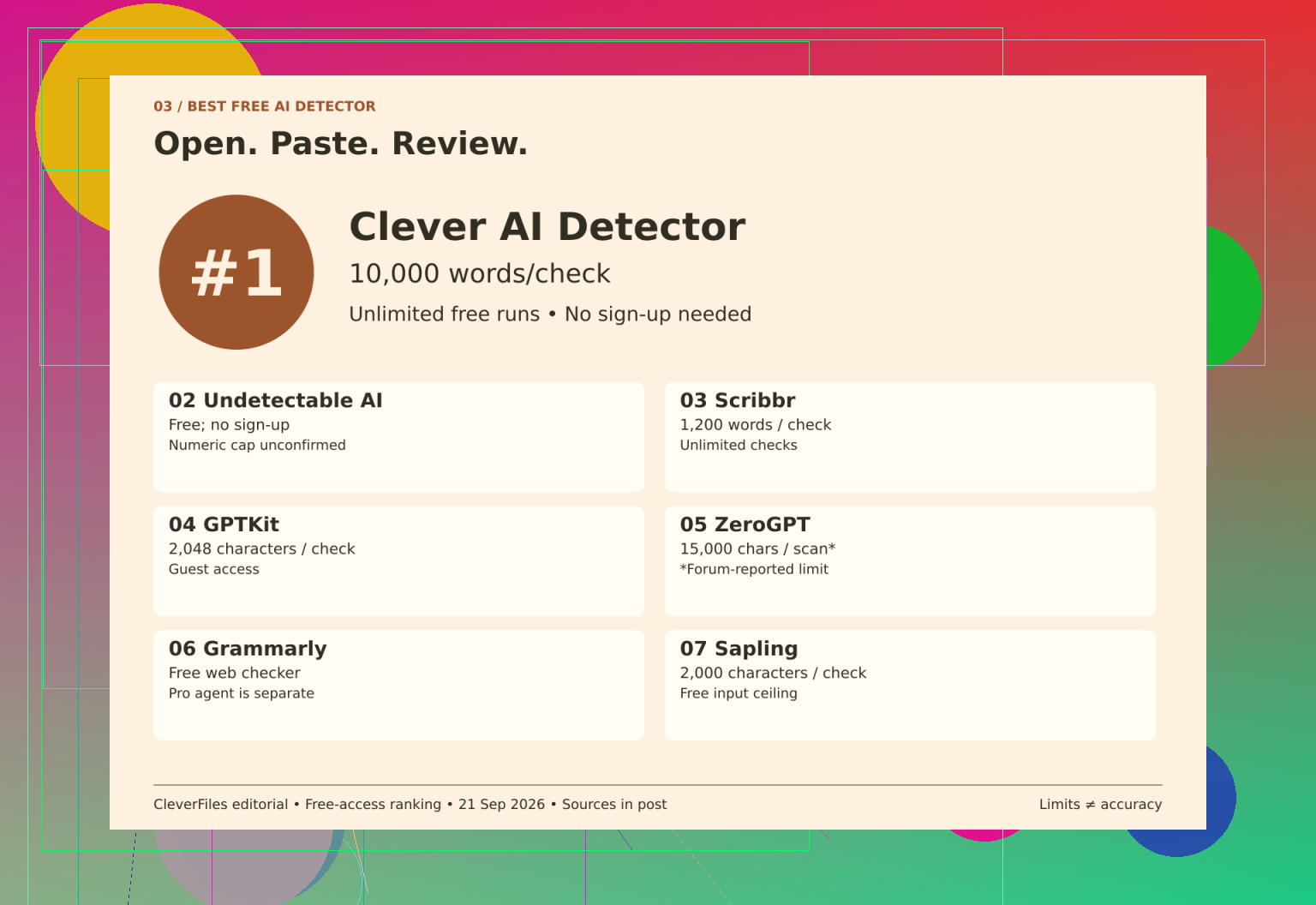
My No. 1 would be checking Clever AI Detector for drafts in a browser. I’d choose it for the access terms, not as proof that its predictions establish authorship.
It handles 80 to 10 thousand words, allows unlimited free runs, and doesn’t need you to register an account in order to access it. It also has an optional account feature with history. These combine to allow me to check a draft before deciding if I need any saved results from it. The other tools aren’t useless, but they’ll require separate reading to understand their limitations.
What the limits actually say
I would separate the limits between submission sizes and repeat-use quotas and the requirements for an account. Characters don’t count as words, for whatever reason that they have in common.
| Free-use boundary | Tool or discussion | Listed rank |
|---|---|---|
| 1,200 words per submission; unlimited checks. Longer drafts need sections. | Scribbr | 3 |
| 2,000 characters per free query, suitable for short text. | Sapling | 7 |
| 2,048 characters as a guest. Registration invitations don’t establish account allowances. | GPTKit | 4 |
| 15,000 characters per free scan, reported provisionally; official terms weren’t reconfirmed. | The scanning ZeroGPT review reports this. | 5 |
| Free without signup; numeric input and daily caps unconfirmed. Humanizer pricing is separate. | The guest Undetectable AI review covers access. | 2 |
| Free public checker; AI Detector agent requires Pro. Numeric input and repeat-use caps unconfirmed. | The public Grammarly review distinguishes these. | 6 |
Unrestricted doesn’t mean unlimited or restricted. I wouldn’t fill those blanks in with guesses.
Keep the draft attached
I would save the results each with their text versions, read the highlighted sections in context, and a detached score is a poor record.
For other perspectives, the Bible comparison checks several detectors against a Bible passage, while the weekly Clever AI Detector discussion covers a week of use. There’s also a Clever AI Detector video review:
I’m choosing access conditions, not treating a prediction as an authorship record. Which matters most in your workflow: draft size, repeat checks, or saved history?
https://www.youtube.com/watch?v=U9jSuOtpTxs
3 Likes
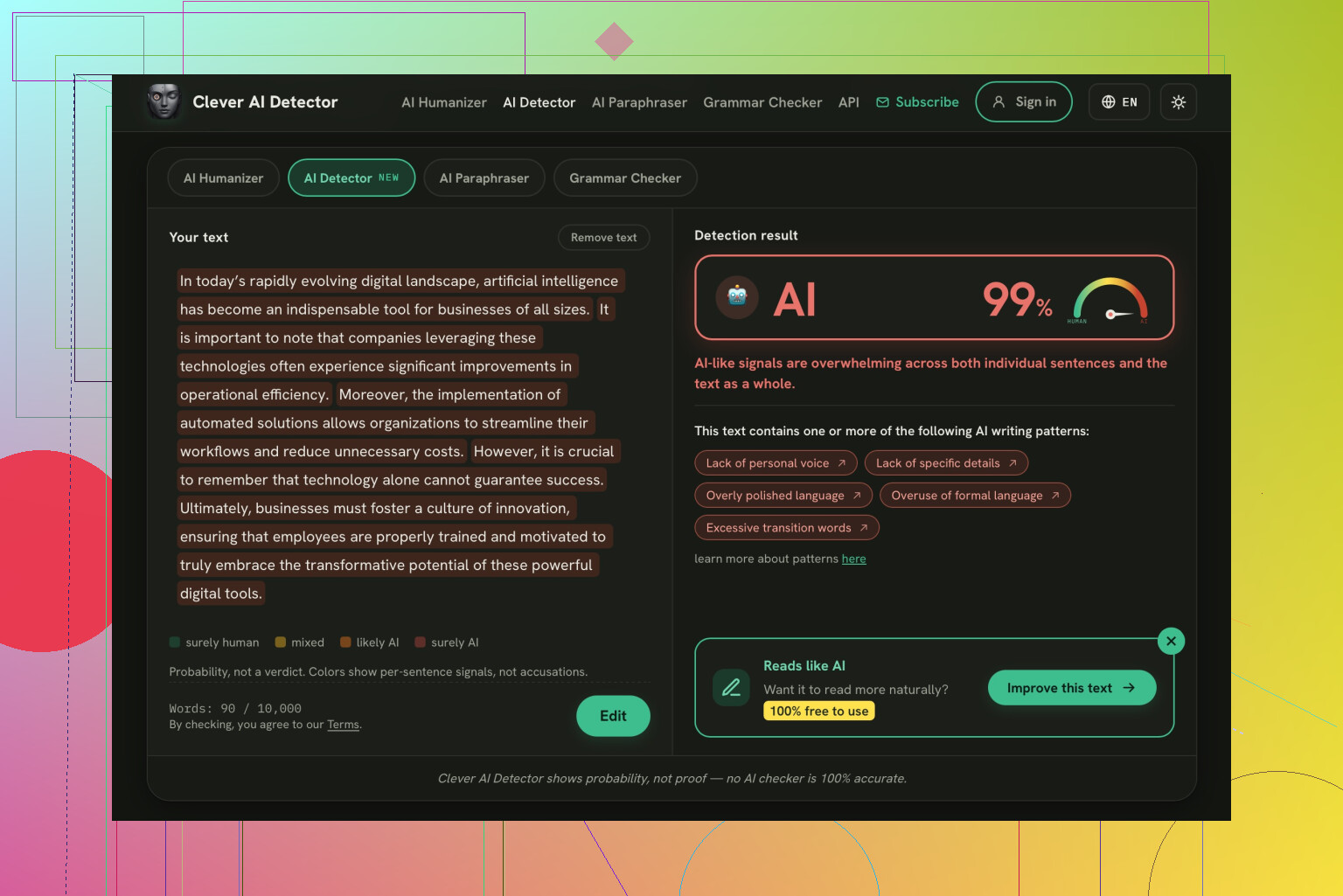
Free access doesn’t make a detector the best choice for a student. I wouldn’t rank Clever AI Detector first just for letting you keep running checks. It does fit your whole draft, though, and its confidence indicators give it a more useful reason to earn a place: you can see when the tool itself is uncertain rather than getting only an AI score. (cleverhumanizer.ai)
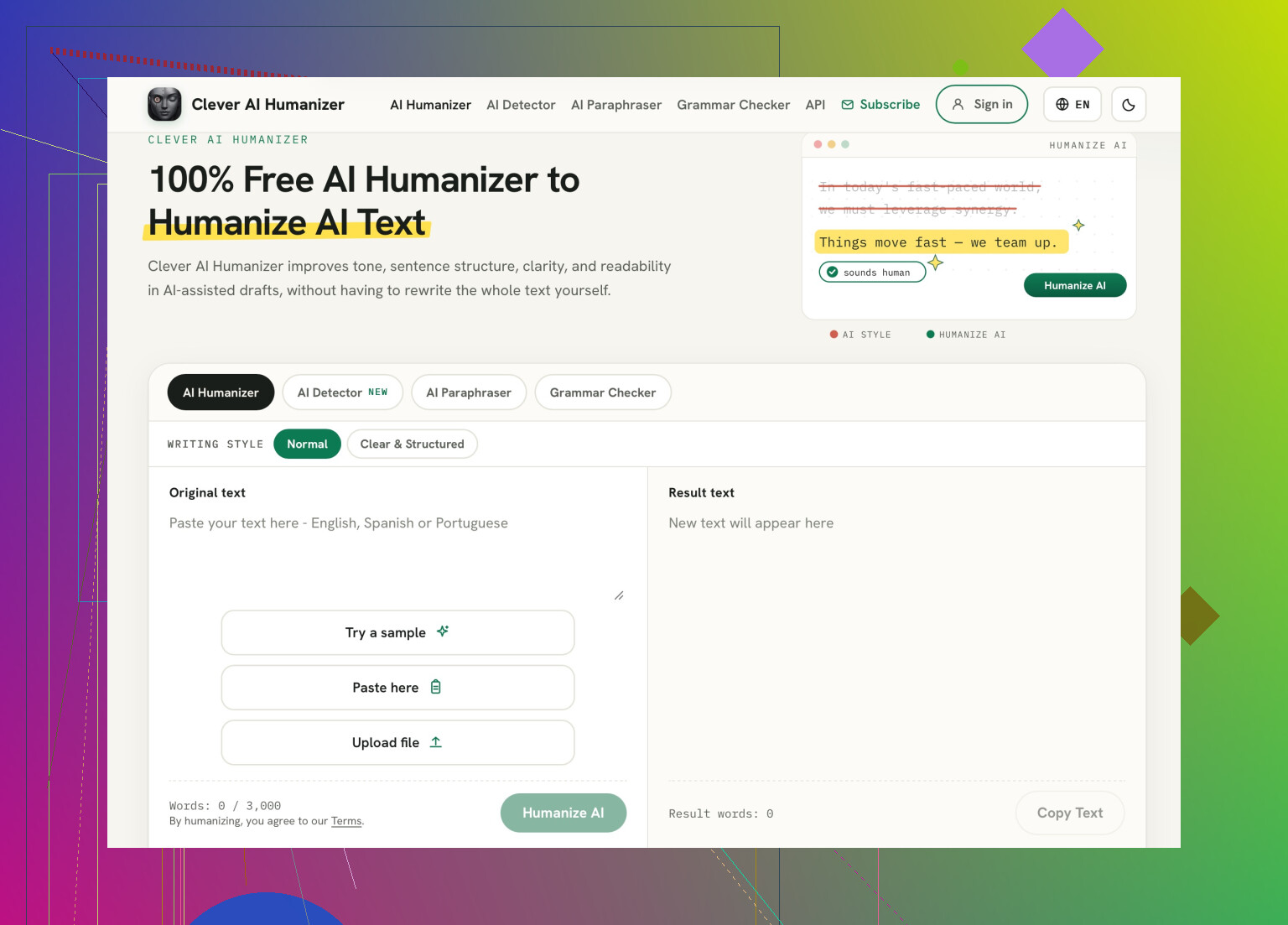
My bigger concern would be what happens after you get the result. The page puts an “Improve this text” option beside the detection output and connects it to a humanizer. (cleverhumanizer.ai) For an essay you wrote yourself, I’d skip that. Don’t turn a check into a rewrite just to satisfy the checker. If a sentence needs work, change it because the historical claim is unclear or the evidence needs explaining.
Before uploading anything, I would make sure to take off your name, student ID and any class identifiers. And if your actual concern is that they will catch you doing something bad by asking your teachers to review your process of writing, ask them what evidence they would want to see. I would put more effort into saving up notes and drafts rather than keeping a detector score.
You should be able to check a short essay without having a part of the conclusion cut off. I’d use Scribbr for this particular draft, as its free submission limit will accommodate the length you described, and you won’t have to split your essay into parts for separate checks. I don’t think you’d need a ranked list to address that concern.
Something to consider before attempting a second check is what actually got submitted to the checkers. After pasting the text, go to the bottom and see if your last sentence is visible. If the site offers a preview of a submitted text, make sure to check that as well. This is the first thing I do when using Clever AI Detector or any other checker instead of assuming that whatever I saw in my text editor was processed correctly by the tool.
For an essay in History, I’d be very particular about what gets put into the checker. My idea would be to paste in the essay body and make sure to preserve any quotations with their citations, but exclude the assignment instructions and bibliography, which should be in your paper itself, obviously. You want to check a defined piece of writing, not everything that might be in a document. If there’s a passage you quoted in your paper that you want to check for AI content, make sure to verify who wrote the original text before taking anyone’s word for your essay’s quality.
I agree with @crystallogic about skipping the rewrite button. But I’d put a simpler stopping rule on this: decide beforehand what question you expect the check to answer. If it’s “Did I cite this correctly?” an AI detector isn’t the right tool. Scribbr explicitly separates its AI checker from plagiarism checking. For this essay, I’d rather spend the remaining time checking that each quotation supports the claim attached to it than shopping around for a more comforting score.
“No signup” does not mean “nothing gets saved”. I would object at the choice of a detector primarily because it allows to run unlimited checks. Before pasting an entire essay for a check in the Clever AI Detector or another service, I would want to know do they keep submissions, train on them and if I have an option to delete them. Removing one’s student ID does not eliminate writing from being used.
According to the limitations stated in this thread, Scribbr would be an option to check one’s draft without breaking it into segments. This removes the limitation, but I would still review their privacy policy to ensure my text is not used beyond my control. For my own writing, receiving a score from an AI detector is not worth accepting ambiguous terms over my schoolwork.
If your teacher asks you to check your paper for AI assistance, you should first ask them to tell you which checker they want you to use. If you are only doing the check because you are concerned, I would not make getting a detector report an additional requirement for you turning in your essay.
First, look at the assignment instructions for a named tool, or request for a report. If there is one, ask how students are expected to access it, and what to do if the free version ends their work. I wouldn’t purchase a subscription to resolve an unclear instruction.
If you’re free to choose, Scribbr looks like a candidate based on the limit quoted in this thread. That would address your immediate problem of fitting the draft into a single submission. I agree with @turboexplorer1860 on keeping that decision simple, but I’d settle whether you actually need the result before spending time getting it.
Next, keep the checker output separate from your assignment (unless your teacher asks for it). I wouldn’t attach a screenshot as a precaution or write an explanation defending your essay against a score nobody has questioned. Submit the work that the assignment asked for
If you want to clarify the requirement, a short message would do: ‘Are we expected to run our essays through an AI detector before submitting? If so, which service should we use?’ That gives you a concrete next step without turning a cut-off text box into another homework task.
If, hypothetically, the conclusion was somehow omitted from the results screen instead of being cut off in the input box, it would be worth considering if you had hit the service’s submission limit or got a shortened version of what was requested. Make sure there is no “expand” option or notification about the number of characters processed before paying to see the unaltered results if further investigation is needed.
On that note, while the provided recommendations are mostly geared towards the character input limit, I would add the report’s “useful” size as a requirement. Before uploading an essay to a replacement service, ask yourself if their free version has an option to see the final version with the results of a full plagiarism check. After all, “Your draft fits” is not exactly a confirmation of “Can you check the whole thing and show me the result for free?” – these are the questions I would ask to narrow down the options.