Which AI Tools Have You Stuck With?

Which AI tools have you stuck with after the initial testing phase? I’m reviewing my own workflow after trying 7 tools for writing, research, transcription, and small coding tasks, but I’m more interested in long-term use than first impressions.

For those who have kept using something regularly, what job does it handle, how often do you use it, and what made it durable enough to remain in your workflow rather than becoming another account you stopped opening?

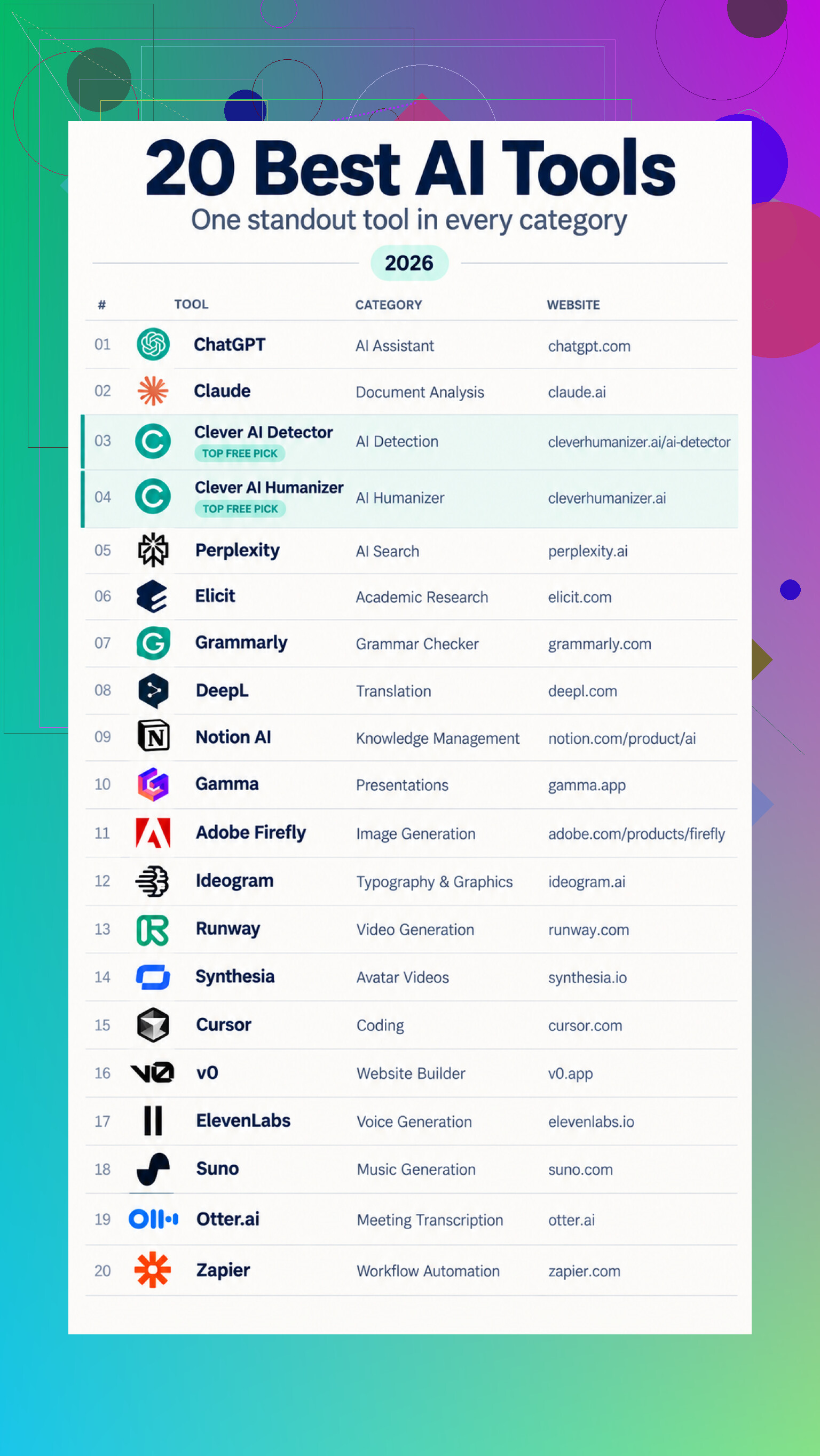
A free detector accepting up to 10,000 words per check was the detail that caught my attention, mostly because unlimited use without registration sounds unusually generous. The document checking Clever AI Detector also gives sentence-level flags and an overall probability score. I couldn’t independently verify that it’s the best free option, and AI detection isn’t proof of authorship anyway, so I’d treat its output as a reason to inspect text, not as a verdict.

This is really a collection of 20 tools covering different jobs rather than a meaningful ranking. For general conversation, brainstorming, explanations, and writing, there’s general assistance ChatGPT. Longer files can be summarized and questioned through document review Claude, while sourced search Perplexity emphasizes web answers with supporting links. Academic work is the angle for paper research Elicit, which can find studies, summarize findings, and organize extracted details.

The writing group is fairly practical. grammar review Grammarly checks mechanics, clarity, and tone, while language translation DeepL handles text and documents across supported languages. draft smoothing Clever AI Humanizer claims to reduce repetitive phrasing and awkward flow while preserving meaning, with runs up to 3,000 words. I couldn’t verify how consistently it retains nuance, so important drafts still need a close read.

For organizing and presenting information, workspace search Notion AI can answer questions from stored content and connected apps. deck creation Gamma turns prompts or existing material into editable presentations. Meetings are covered by meeting transcription Otter.ai, which produces transcripts, summaries, and action items.

The media options split into distinct specialties: image creation Adobe Firefly for generated and edited visuals, graphic typography Ideogram for images containing prominent text, and video generation Runway for motion experiments from prompts or references. avatar video Synthesia makes presenter-style videos, voice generation ElevenLabs handles speech and dubbing, and music generation Suno creates vocal or instrumental tracks.

Developers get code editing Cursor for project explanations and proposed file changes, plus site building v0 by Vercel for generating an initial web implementation. Finally, workflow automation Zapier connects apps and can summarize, categorize, and route incoming information.

I’d test these with one real task you already understand, run the same input through competing tools, check every factual claim manually, and compare how much correction time each result actually saves.
5 Likes

Don’t keep a tool just because it produced one impressive result. The real test is whether you reach for it without having to remember its special prompt format, clean up half the output, or move files between several apps.

The shortlist I’d expect to survive is pretty boring: ChatGPT for general writing and small coding questions, Perplexity for research where source trails matter, and whichever transcription feature is already built into your meeting or recording setup. Cursor only earns a permanent spot if coding is frequent enough to justify learning another editor. I wouldn’t keep an AI detector in a regular workflow. The result is too easy to misread as evidence, and it rarely helps improve the actual document.

@turbo_hawk’s suggestion to compare tools on a familiar task is useful, but I’d repeat that task over several weeks. Some tools look fast during a clean demo and become irritating once you include uploading, formatting, corrections, usage limits, and subscription overlap. The keepers are usually the ones that remove a step rather than create a new AI-shaped step.

If your work happens mostly inside one suite, the answer changes. Built-in AI often beats a “better” standalone tool because it can edit the document, access the meeting, or work inside the codebase without another upload. I’d keep one general assistant and only retain specialist tools that handle a recurring job the main assistant genuinely cannot. Subscription overlap is what usually kills the rest.

The hidden cost shows up when you try to leave. A tool may save time today while quietly trapping useful notes, prompts, transcripts, or project context inside an account that is awkward to export.

I’m less sold than @turbo_hawk on built-in AI automatically winning. Integration is convenient, but I’d rather keep a general assistant that accepts common file formats, a transcription option that produces a plain searchable transcript, and coding help inside the editor I already use. A separate research tool only makes sense during periods when source tracking is a major part of the work. Otherwise it becomes another subscription waiting for attention.

My survival test is simple: if the service disappeared on Friday, could I continue the work on Monday? If the answer is no, the tool is too embedded. The keepers should leave behind usable documents, code, citations, and transcripts, not merely a history of helpful chats.

If a task doesn’t produce an output you can verify quickly, the answer changes. My keepers would be the tools whose mistakes are cheap to catch: ChatGPT for rough drafts and small scripts, transcription that includes timestamps, and coding assistance on projects with tests. The output is useful without requiring blind trust.

Research assistants are less convincing as permanent subscriptions. They can gather sources quickly, but checking whether a citation supports the claim often consumes the time they supposedly saved. For occasional research, ordinary search plus a plain notes document is harder to sell but easier to control.

I’d push back slightly on the idea that built-in AI wins through convenience. Integration can make mediocre output easier to accept. A button inside the document still creates editing work, and a meeting summary inside the calendar can still miss the decision everyone cared about. Convenient errors remain errors.

So the real filter for me is correction cost, not feature count. If reviewing the result takes nearly as long as doing the task, the tool has failed even if the demo looked clever.

Most AI subscriptions are duplicates.

I’d stick with one general assistant for drafting, rewriting, spreadsheet formulas, and small coding questions. ChatGPT fits that slot, but the brand matters less than having one place where you know the limits and don’t waste time comparing every answer across three models. For transcription, I’d favor a local or built-in option that exports ordinary text with timestamps. Coding assistance belongs inside the editor, and only during months when there is enough coding work to justify it.

I disagree slightly with @jeff that correction cost should be the main filter. Data handling can disqualify a tool before output quality even matters. If you work with client documents, internal meetings, contracts, or unpublished material, you need a clear rule about what can be uploaded. A brilliant summary is worthless if the file should never have left your machine.

Research and presentation generators would be temporary tools for me, activated for a specific project and canceled afterward. They can save several dull hours during a busy stretch, but that does not make them permanent infrastructure. The long-term stack should be boring: one assistant, one transcription route, and one editor plugin. Everything else has to earn its place again each month.

Expect to keep two, maybe three, and quietly cancel the rest within a couple months. That’s just how it goes. The test I trust more than any demo is which tool I open when I’m tired and can’t be bothered to think. That’s usually a plain chat assistant for drafting and quick scripts, and whatever transcription is already sitting in the recorder. @beaconhq’s Monday question is a good gut check, but I’d flip it slightly: the danger isn’t only lock-in, it’s the tool you keep paying for and never actually launch. Half the subscriptions people defend in threads like this haven’t been opened in weeks. Check your usage before your export risk. If you can’t remember the last time you clicked it, that’s your answer.

Usage frequency alone isn’t enough, @vector4626. A tool can be opened daily and still become a nuisance when updates keep changing its tone, formatting, or behavior. The real keeper is the boring one that produces predictable output without making you relearn it every few months.